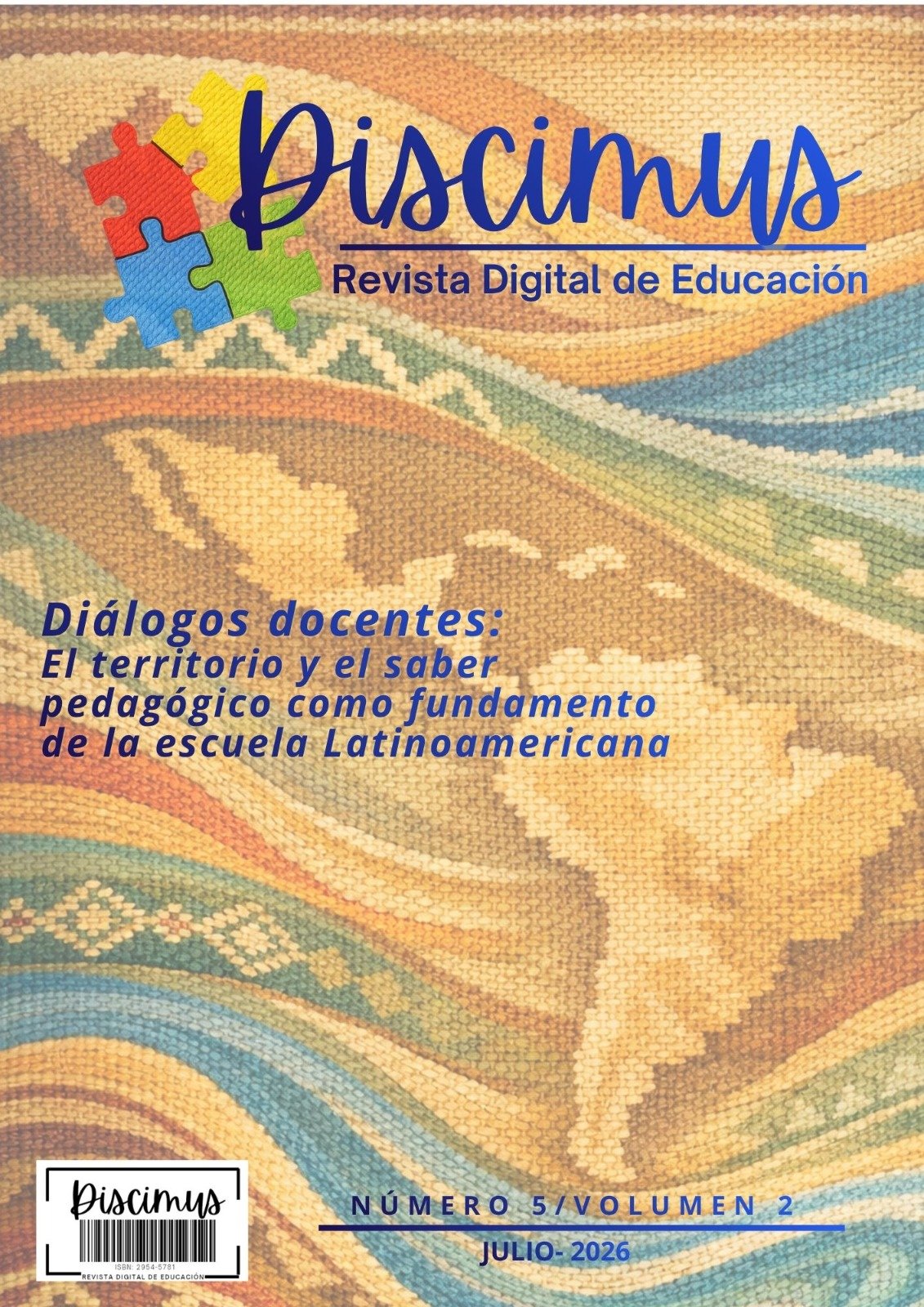

The office of discomfort: notes from the south for a teaching writing that disturbs reality
Main Article Content
Abstract
This paper explores teachers' academic writing as an act of political intervention rather than merely a technical dissemination skill. It problematizes the tension between an aseptic writing, inherited from an instrumental rationality that permeates educational policy, and a writing anchored in territorial experience and memory. It argues that the act of narrating the school from a critical position, recognizing technological mediations and the cracks in the system, constitutes a form of pedagogical resistance. The weight of normative tradition in citizenship education is analyzed, as well as how it has shaped a teaching subjectivity fearful of the first person. Likewise, the potential of the essay as a border genre capable of accommodating the complexity of educational practice in contexts of conflict and post-agreement is examined. It concludes that the construction of academic networks among peers from the Global South is vital to overflow formalisms and recover the teacher's voice as a legitimate interpreter of social complexity.
Downloads
Article Details
Section

This work is licensed under a Creative Commons Attribution-NonCommercial-ShareAlike 4.0 International License.
Open Access Policy at Discimus Journal
Discimus Journal is committed to the promotion of free circulation of scientific and academic knowledge, simultaneously ensuring appropriate acknowledgment for our authors while adhering to the ethical principles of scientific publishing. In alignment with this goal, Discimus publishes all its articles under the ATTRIBUTION-NONCOMMERCIAL-SHAREALIKE 4.0 INTERNATIONAL CC BY-NC-SA 4.0
How to Cite
References
Castillo, L., & Garzón, B. (2020). Youtube, ¿un camino hacia la interculturalidad participativa? En YouTube y la comunicación del siglo XXI (pp. 21-36). CIESPAL, UPS.
Defensoría del pueblo. (2024). Defensor del Pueblo presenta el primer informe sobre educación en derechos humanos en Colombia. https://www.defensoria.gov.co/-/defensor-del-pueblo-presenta-el-primer-informe-sobre-educaci%C3%B3n-en-derechos-humanos-en-colombia
Freire, P. (1969). La Educación como práctica de la libertad. Siglo XXI Editores.
González Valencia, G. A. (2015). Concepciones sobre la educación política en Colombia: entre la tradición y la transformación. Revista Educación y Pedagogía, 27(69-70), 23-28. https://revistas.udea.edu.co/index.php/revistaeyp/article/view/327783
Gutiérrez Slon, J. A., & Vargas Vargas, B. R. (2022). Entablando diálogos con Freire: sobre el espacio pedagógico y otras reflexiones compartidas. Revista Innovaciones Educativas, 24(37), 231-243. https://dx.doi.org/10.22458/ie.v24i37.3963
Habermas, J. (1985). Conciencia moral y acción comunicativa (6.ª ed.). Península.
Leguizamon, D. y Sandoval, E. (2019). Pedagogía para la paz: contexto de posacuerdo en la frontera colombo venezolana. Revista Electrónica en Educación y Pedagogía, 3(5), 110-128. https://doi.org/10.15658/rev.electron.educ.pedagog19.09030507
Martín-Barbero, J. (1991). De los medios a las mediaciones. Comunicación, cultura y hegemonía (2.ª ed.). Editorial Gustavo Gili.
Mejía, A., & Perafán, B. (2006). Para acercarse al dragón, para amansarlo, es necesario haberlo amansado primero: una mirada crítica a las competencias ciudadanas. Revista de Estudios Sociales, (23), 23–35. http://journals.openedition.org/revestudsoc/22113
Navarro, F., Ávila Reyes, N., Tapia-Ladino, M., Cristovão, V. L. L., Moritz, M. E. W., Narváez Cardona, E., & Bazerman, C. (2016). Panorama histórico y contrastivo de los estudios sobre lectura y escritura en educación superior publicados en América Latina. Revista signos, 49(Supl. 1), 78-99. https://dx.doi.org/10.4067/S0718-09342016000400006
Pinilla, A. y Torres, J. (2006). De la educación para la democracia a la formación ciudadana: una década de incertidumbre. Universidad Pedagógica Nacional.
Ricoeur, P. (2000). La memoria, la historia, el olvido. Trotta.
Rodríguez Ávila, S. P. (2012). Formación de maestros para el presente: memoria y enseñanza de la historia reciente. Revista Colombiana de Educación, (62), 165-188. http://www.scielo.org.co/scielo.php?script=sci_arttext&pid=S0120-39162012000100008
Rodríguez Ávila, Y. (2007). El ensayo: una estrategia para la promoción de la escritura en el instituto pedagógico rural "Gervasio Rubio". Investigación y Postgrado, 22(2), 231-258. http://ve.scielo.org/scielo.php?script=sci_arttext&pid=S1316-00872007000200010
Rodríguez, Y., y Cruz, N. (2017). La educación para la paz y los derechos humanos: Una mirada desde Cuba. Revista Electrónica en Educación y Pedagogía, 1(1), 91-105. http://dx.doi.org/10.15658/rev.electron.educ.pedagog17.09010106
Rojas, A. F., Rondón, J. F., & Salazar, A. F. (2020). Construcción cultural en el currículo colombiano: un estudio de los tres Planes Nacionales Decenales de Educación (Trabajo de grado). Universidad Pedagógica Nacional. http://hdl.handle.net/20.500.12209/12196
Ruiz Barbot, M. (2017). La escuela burbuja, la escuela extraña, la escuela vana: huellas de la educación en jóvenes uruguayos. INFEIES - RM, 6(6), 184-220. https://www.infeies.com.ar/numero6/Ruiz.pdf
Santisteban, A. (2004). Formación de la ciudadanía y educación política. En M. Vera y D. Pérez, (Coords.), Formación de la ciudadanía: las TICs y los nuevos problemas. AUPDCS. http://dialnet.unirioja.es/servlet/articulo?codigo=1454090
Saredo, F., Kanovich, S., Grattarola Adinolfi, S., Estévez, J., Molinelli, R., & Ferreira, R. (2024). Enseñanza de la lectura y la escritura en la universidad: recorridos colaborativos de investigación-acción. Revista mexicana de investigación educativa, 29(103), 885-911. http://www.scielo.org.mx/scielo.php?script=sci_arttext&pid=S1405-66662024000400885&lng=es&tlng=es
Valencia Arias, J. (2015). La resocialización y la reincidencia de adolescentes en conductas delictivas en el Departamento de Caldas, Colombia. Summa Iuris, 3(2), 377-390. https://www.funlam.edu.co/revistas/index.php/summaiuris/article/view/1834/1464
Vega Angarita, O. M. (2021). Resultados de aprendizaje: contexto normativo y conceptual en el marco actual del aseguramiento de la calidad. Revista Ciencia y Cuidado, 18(2), 5-7. https://revistas.ufps.edu.co/index.php/cienciaycuidado